
What Are the Biggest Digital Marketing Trends in 2026?
Digital marketing is changing faster in 2026 than it has in many previous years. Search behavior is shifting toward AI-powered platforms, social media is becoming a discovery and shopping channel, video continues to attract significant advertising investment, and marketers are placing greater emphasis on first-party data, personalization, automation, and measurable business outcomes.
For businesses, this means that simply following the same digital marketing strategies used in previous years may not be enough. The focus is increasingly moving from generating clicks and impressions to understanding how customers discover brands, how they research products, and what ultimately influences a purchase.
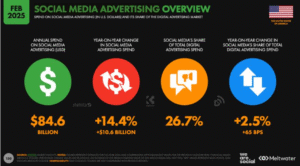
The U.S. market provides a useful view of this shift. U.S. internet advertising revenue reached $294.6 billion in 2025, growing 13.9% year over year. Social advertising reached $117.7 billion, search advertising reached $114.2 billion, and digital video advertising reached $78 billion.
U.S. Digital Marketing at a Glance
The numbers show how significant digital channels have become for U.S. businesses.
- $294.6 billion — U.S. internet advertising revenue in 2025
- 13.9% — year-over-year growth in U.S. internet advertising revenue
- $117.7 billion — U.S. social advertising revenue
- $114.2 billion — U.S. search advertising revenue
- $78 billion — U.S. digital video advertising revenue
- $63.4 billion — U.S. commerce media revenue
- $162.4 billion — U.S. programmatic advertising revenue in 2025
The Interactive Advertising Bureau also raised its forecast for 2026 U.S. advertising spend growth to 12.3%, citing stronger-than-expected first-half performance and continued changes in how consumers discover, evaluate, and choose brands.
U.S. Internet Advertising Revenue, 2021–2025
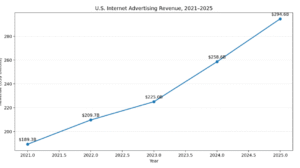
Original chart created for this article using IAB/PwC reported U.S. internet advertising revenue data.
The growth from $189.3 billion in 2021 to $294.6 billion in 2025 demonstrates how quickly the U.S. digital advertising ecosystem has expanded.
1. AI Is Becoming a Core Part of Digital Marketing
One of the biggest AI marketing trends in 2026 is the movement from experimenting with AI to integrating it into everyday marketing operations.
AI is now being used across research, content workflows, audience analysis, customer service, personalization, campaign optimization, creative development, and data analysis.
Experian’s 2026 digital trends research reports that 94% of marketers are investing broadly in AI to drive efficiency and impact. The report also highlights the growing importance of connecting AI with data, measurement, and marketing outcomes.
However, AI should not simply mean producing large volumes of automated content.
The more important opportunity is using AI to help marketers work with existing customer and business data more effectively. For example, AI can help identify patterns in customer behavior, segment audiences, analyze campaign performance, summarize research, personalize experiences, and support faster decision-making.
This makes AI-driven digital marketing one of the defining digital marketing trends for businesses in 2026.
2. AI Search Is Changing SEO and Customer Discovery
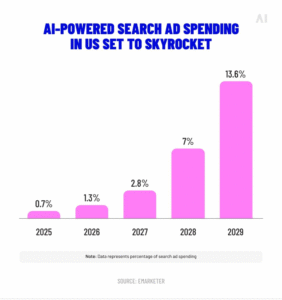
Another major digital marketing trend in 2026 is the growth of AI-powered search and conversational discovery.
Consumers increasingly use AI tools to research products, compare businesses, understand complex topics, and create shortlists before visiting a traditional website.
HubSpot’s 2026 marketing research reports that half of consumers surveyed use AI-powered search, while half of Google searches include an AI Overview.
This is changing the way businesses think about SEO.
Traditional SEO remains important, but marketers are increasingly considering AI search optimization, Answer Engine Optimization (AEO) and Generative Engine Optimization (GEO).
The goal is not simply to rank a webpage for a keyword. Brands also need content that clearly answers questions, demonstrates expertise, provides trustworthy information, and can potentially be understood and referenced by AI-powered search systems.
This means AI SEO trends 2026 are closely connected with traditional technical SEO, high-quality content, structured information, entity understanding, and brand authority.
3. Search Is Becoming More About Visibility Than Just Clicks
One of the most important changes in the future of digital marketing in 2026 is how marketers measure search performance.
Huble’s 2026 analysis highlights the shift toward zero-click experiences and AI-generated answers, arguing that visibility within search and AI environments can matter even when a user does not immediately click through to a website.
This does not mean website traffic is no longer important.
Instead, marketers need to look at a broader set of signals.
A brand may be discovered through an AI answer, remembered by the customer, searched directly on Google later, and eventually converted through a website visit.
As a result, digital marketing strategies 2026 need to consider brand visibility, branded searches, organic traffic, direct traffic, conversions, assisted conversions, and revenue rather than focusing on one metric alone.
4. Short-Form Video Continues to Grow
Video remains one of the most important social media marketing trends 2026.
Short-form video has become an important format for product discovery, education, entertainment, creator marketing, and brand storytelling.
The U.S. digital advertising data reinforces this trend. Digital video advertising revenue reached $78 billion in 2025, increasing 25.4% year over year according to IAB/PwC.
U.S. Digital Advertising: Selected 2025 Revenue Figures
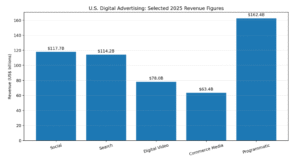
Original chart created for this article using IAB/PwC reported U.S. advertising data.
For marketers, video is no longer limited to traditional brand campaigns. Businesses can use short videos for product demonstrations, customer education, testimonials, behind-the-scenes content, FAQs, tutorials, and creator collaborations.
The key is making the content useful rather than producing video simply because it is popular.
5. Social Media Is Becoming a Search and Shopping Channel
Social media platforms are increasingly functioning as discovery engines.
Consumers can discover a product, watch a review, compare alternatives, interact with a creator, visit a product page, and sometimes complete a purchase without leaving the platform.
This is why social commerce trends 2026 and social search 2026 are becoming important parts of digital marketing planning.
IAB/PwC reported that U.S. social advertising revenue reached $117.7 billion in 2025, growing 32.6% year over year. The organization linked growth partly to creator-economy expansion, commerce integration, and improvements in targeting, measurement, and attribution.
For brands, social media therefore needs to be viewed as more than a platform for posting updates.
It can support awareness, discovery, community building, customer service, product research, remarketing, and sales.
6. First-Party Data Is Becoming More Important
Another major digital marketing trend 2026 is the increased importance of first-party data.
As privacy expectations evolve and marketers face limitations around certain third-party data practices, businesses are paying greater attention to information they collect directly from customers.
This can include website interactions, purchase history, newsletter subscriptions, customer preferences, loyalty activity, CRM information, and consented behavioral data.
Experian reports that 70% of B2B marketers plan to increase their use of first-party data, making it one of the important areas of focus in its 2026 trends research.
First-party data can also improve personalization.
Instead of delivering the same message to everyone, brands can create more relevant experiences based on customer interests, previous interactions, purchase behavior, or stage in the buying journey.
7. Personalization Is Moving Beyond Basic Recommendations
Personalization has been discussed in digital marketing for years, but personalization trends in marketing are becoming more sophisticated in 2026.
Customers increasingly expect businesses to understand their needs and provide relevant experiences.
Personalization can appear across:
- Website experiences
- Email campaigns
- Product recommendations
- Advertising
- Landing pages
- Customer support
- Retargeting
- Offers and promotions
AI is making it easier for marketers to process larger amounts of customer information and create more relevant experiences at scale.
However, effective personalization depends on accurate and responsibly managed data. Poor-quality customer data can lead to irrelevant recommendations and a frustrating experience.
8. Performance Marketing Is Becoming More Outcome-Focused
The growth of digital advertising is also increasing pressure on marketers to demonstrate business value.
IAB reported that U.S. programmatic advertising revenue reached $162.4 billion in 2025, up 20.5% year over year.
At the same time, marketers are paying closer attention to customer acquisition cost, return on ad spend, conversion rates, lifetime value, revenue, and retention.
This makes performance marketing trends 2026 less about generating the largest possible volume of traffic and more about understanding which activities contribute to meaningful business results.
For ecommerce brands, this can mean connecting advertising data with product margins, average order value, repeat purchases, and customer lifetime value.
9. Commerce Media Is Becoming a Bigger Advertising Opportunity
Commerce media is another important area to watch.
U.S. commerce media revenue reached $63.4 billion in 2025, growing 18% year over year according to IAB/PwC.
Commerce media allows advertising to connect more closely with shopping environments and purchase-related data.
This is particularly relevant for retailers, marketplaces, ecommerce brands, and businesses with strong transactional customer data.
As ecommerce and advertising become more connected, marketers can increasingly use shopping behavior to understand audiences and create more relevant advertising experiences.
10. Measurement Is Becoming More Complex
Perhaps the biggest lesson from the latest digital marketing trends 2026 is that measurement is becoming more complicated.
A customer journey may now involve Google, an AI search platform, Instagram, YouTube, a marketplace, a brand website, an email, and a remarketing campaign.
Attributing the final purchase to only one channel can therefore provide an incomplete picture.
Marketers need to understand how different channels contribute throughout the customer journey.
This means dashboards increasingly need to bring together SEO, paid advertising, social media, CRM, ecommerce, analytics, and conversion data.
The objective is not simply to know where the customer clicked, but to understand what influenced the customer to make a decision.
What Do These Digital Marketing Trends Mean for Businesses?
The biggest digital marketing trends in 2026 are connected.
AI is changing search.
Search is changing how people discover brands.
Social media is becoming a discovery and shopping environment.
Video is capturing increasing advertising investment.
First-party data is becoming more valuable.
Personalization is becoming more sophisticated.
And measurement is moving toward business outcomes rather than isolated channel metrics.
For businesses, the response does not necessarily need to be investing in every new platform.
Instead, companies should evaluate where their customers actually spend time, how they search for information, which content formats influence them, and which channels contribute to revenue.
A strong digital marketing strategy for 2026 should therefore combine the right mix of SEO, AI search optimization, content marketing, social media, paid advertising, video, first-party data, personalization, analytics, and conversion optimization.
Frequently Asked Questions
What are the biggest digital marketing trends in 2026?
The major digital marketing trends 2026 include AI-powered marketing, AI search optimization, AEO and GEO, short-form video, social commerce, first-party data, personalization, performance marketing, commerce media, and more advanced measurement.
Is SEO still important in 2026?
Yes. SEO continues to play an important role in organic discovery, but the search environment is evolving. Businesses increasingly need to consider traditional search rankings alongside AI-generated answers, zero-click experiences, structured content, and brand visibility across AI search platforms.
How is AI changing digital marketing in 2026?
AI is being used for marketing analysis, automation, personalization, content workflows, campaign optimization, customer service, research, and search experiences. Experian reports that 94% of marketers are investing broadly in AI.
What are the biggest social media marketing trends in 2026?
Important trends include short-form video, social search, social commerce, creator marketing, personalization, community building, and AI-assisted content workflows.
Why is first-party data important in 2026?
First-party data gives businesses information collected directly through their own customer relationships and digital properties. It can support personalization, customer segmentation, measurement, and more relevant marketing experiences.
Is video marketing still effective in 2026?
Video remains an important digital marketing format. U.S. digital video advertising revenue reached $78 billion in 2025 and grew 25.4% year over year according to IAB/PwC.
What should businesses focus on in their digital marketing strategy for 2026?
Businesses should focus on understanding their customers, building strong first-party data foundations, creating useful content, improving search visibility across traditional and AI search, using video and social channels strategically, and measuring marketing against meaningful business outcomes.
Ready to Adapt Your Digital Marketing Strategy for 2026?
The digital landscape is changing, but businesses do not need to chase every new trend. The real opportunity is to understand which digital marketing trends in 2026 are relevant to your audience and connect them into a measurable strategy.
From AI marketing and SEO to social media, content, paid advertising, personalization, and performance marketing, the right combination can help your brand build stronger visibility and create more meaningful customer journeys.
Ready to prepare your business for the next stage of digital marketing? Connect with Snipptech to explore a data-driven digital marketing strategy built around your business goals, audience, and growth opportunities.